Author: John Perry

Vintage alarm clock showing the time on a rustic wooden surface.

Celebrating Our 500th Episode

Philosophy Talk just celebrated our 500th episode. Quite an accomplishment from the point of view of the 1st episode. Let me reminisce for a bit, going back in time to when I first had the idea for the program, getting Ken Taylor on board, creating a pilot episode, and finally getting broadcast in 2004.
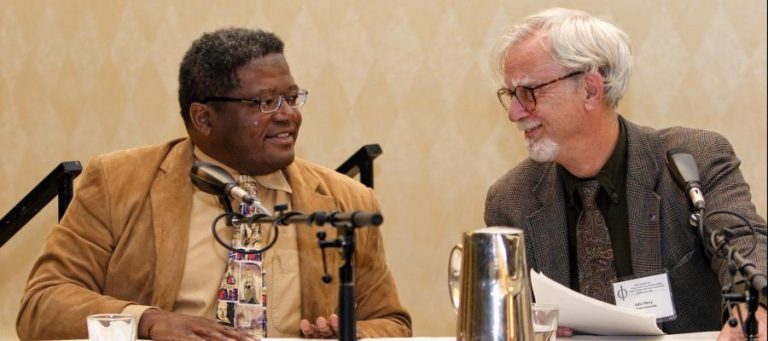
Two men in suits converse at a conference, microphones present.

A Tribute to Ken Taylor

I was shocked and saddened to hear of the death of Ken Taylor, a long time friend, colleague, and co-host. Stunned, actually. A great man with a wonderful family, who have my deepest sympathy. I always thought of Ken as my younger brilliant energetic colleague. It wasn’t his turn to die.

Two blue Adirondack chairs on a sandy beach facing the ocean.

Thoughts on Retirement

Retirement, as we think of it, goes like this. A person has a right, or maybe a duty, but at least a choice, to retire at a certain age, and between the government, his or her employers, and their own diligence, should have a pension to live on for the rest of their days.

Person standing on mountain overlooking a lake and valley.

Phenomenology

Husserl founded phenomenology a century ago. Many important philosophers are phenomenologists, like Heidegger, Merleau-Ponty, and Sartre. But what in the world is phenomenology?

Star trails circling a dark mountain range at night.

Space, Time, and Space-time

Scientists tell us that space and time are really aspects of a single thing, the space-time continuum, that time has no intrinsic direction, and that there is really no such things as objective, observer independent simultaneity, and maybe time travel is possible after all.

A half-round mirror reflects a plant and sheer curtains.

Take the Mirror Test

When YOU look at yourself in a mirror, WHO do you see there? The mirror test is a technique developed by psychologist Gordon Gallup Jr. as an attempt to determine whether a non-human animal possesses the ability of self-recognition.

Large crowd of people with raised hands at a conference or event.

Free Speech on Campus

When a Stanford student posts a picture of a lynching on a the door of an African-American student with the words “Go Home” scrawled across the bottom, that is a violation of the honor code. If Stanford expels the student, as I believe it should, it has abridged his or her freedom of speech. But it hasn’t violated the First Amendment.

Earth from space, sun rising over North and South America.

The Mystery of the Multiverse

Throughout human history, every time we think we know what the universe is, it turns out that there is not just one of those things, but a lot of them. First we thought the universe was Earth, a sun and a moon, and a sky with a lot of mysterious points of lights. Then there turned out to be a number of planets with their own moons. Then a lot of suns, with their own planets: a lot of solar systems.

Silhouette of two hikers helping each other climb a mountain.

Trust and Mistrust

Trust is one pattern of reliance, where the trusting person, or trustor, can’t control what the trusted person, or trustee, does, and may not even know what the trustee does at the time he does it, but plans on the trustee doing one thing rather than another. This pattern of reliance is no doubt essential to social life. But is it rational? Does trust really amount to being stupid, or helpless, or both?

Person in suit casting ballot into a box. Dewey's Democracy

Dewey’s Democracy

Dewey was probably the most important American philosopher of the twentieth century. He died in 1952, in his nineties. He influenced not only abstract philosophical issues – he was a pragmatist – but psychology and education and political philosophy. He was a public intellectual, but also a practical intellectual, who worked tirelessly, especially to transform education.

First Amendment text with gavel; Dewey's Democracy

Do Religions Deserve Special Status?

The First Amendment to the US Constitution protects our right to say and publish whatever we think, but doesn’t in general guarantee the right to do any more than that. I can believe that people shouldn’t wear fedoras, and I can publish my view. But I can’t go around knocking fedoras off the heads of those that wear them, and I may get in trouble if I fire employees for wearing fedoras. But it seems to go further with respect to religion. In addition to ruling out the establishment of a state religion, it also guarantees “the right to the free exercise of [religion].” You cannot only preach what you believe, you can practice what you preach. But just what does this mean? Do we really treat religion in a special way? Should we?

The Philosophy of Puns

A Philosophy Talk show on puns can’t just consist of making puns, even if they…

Hand dropping ballot into a ballot box, exercising the right to vote. Dewey's Democracy.

Struggles of Democracy

Like most words for powerful ideas, “democracy,” is a bit ambiguous, a bit blurry around the edges; the word itself is a contested item in our democracy and others.  It would help if we have a preliminary definition.   I like Lincoln’s.  “Government of the people, by the people, and for the people.”  But now we have to ask what that means.  Here’s my take on it.

Life as a Work of Art

Some philosophers, including the guest on this week’s program, Lanier Anderson, his teacher Alexander Nehamas,…

Vintage yellow streetcar on city street with autumn leaves

Lessons from the Trolley Problem

There is nothing morally special about trolleys, except the historical accident that around thirty years ago the great philosophers Philippa Foot and Judith Jarvis Thomson used trolleys in a series of examples, originally to help us think about moral aspects of abortion. Since that time a zillion articles have been written about the trolley problem, applying it to all sorts of moral issues.

Four children in muddy rain boots stand together, showcasing a sense of community and childhood exploration.

How Many Children?

  The world already has too many people.  7.3 billion.  It’ll probably hit over 11…