
Epicurus and the Good Life
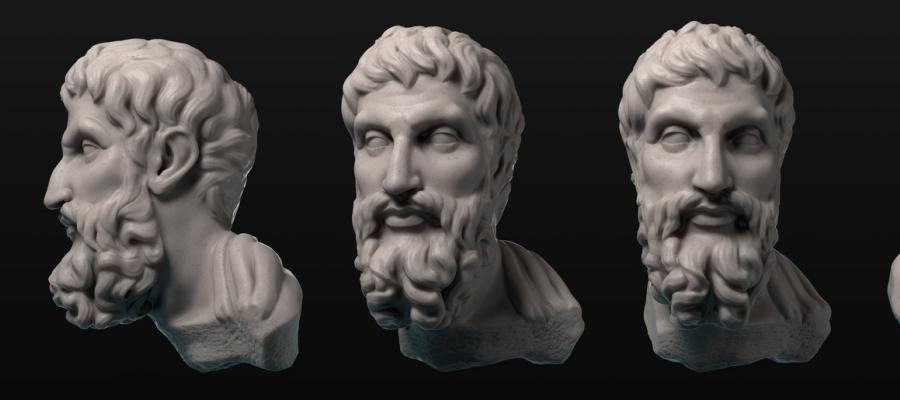
This week’s conversation is about Epicurus and the Good Life. Now in common parlance an epicurean is one who is “fond of or adapted to luxury or indulgence in sensual pleasures; having luxurious tastes or habits, especially in eating and drinking.” But the Ancient Greek philosopher Epicurus was decidedly not an epicurean in that sense of the word. His philosophy is actually pretty far removed from epicureanism as ordinarily understood.
Epicurus did acknowledge that desires for good food and fine wine were natural. But he actually dismissed such desires as entirely unnecessary. And he seemed to believe that in the long run the pursuit of them would set you up for a life of pain and distress. The real key to human happiness, on his view, didn’t involve the pursuit of luxury or excessive sensual pleasures. Rather, it involved the absence of bodily pain and mental distress.
But I don’t mean to make it sound as though he was entirely opposed to what we might call positive pleasures. He just thought we should pursue positive pleasures of the right kind. Those would be pleasures brought about by the satisfaction of what he called our natural and necessary desires – simple desires like the desire for food, or for the company of good friends. He also counted that the state that you are in when you are free of pain and mental distress not as a neutral state of neither pleasure nor pain, but as a positive, though, “calm” state of pleasure.
Now calling some desires natural and necessary may seem to suggest that other desires are unnatural and/or unnecessary. And that is exactly what Epicurus thought. We already gave an example of a natural but unnecessary desire – the desire for fine food and drink — with the emphasis being on the fine, here. An example of a completely unnatural desire is the desire for immortality — a desire borne of the unreasonable fear of death.
Though I am sure some will think that desire not to die is the most natural thing in the world and is perfectly rational too, Epicurus thought that that desire just gets in the way and prevents us from living well. The desire for immortality is bound to go unsatisfied. Unsatisfied desires are the main cause of pain and anxiety. One of Epicurus’s main philosophical aims was to help people free themselves from such desires and to refocus them on the simple and easy pleasures that come from satisfying our natural and necessary desires. If we just rid ourselves of things like the desire for immortality and face death with equanimity, he seemed to believe, everything would be alright.
Part of me thinks that Epicurus needs to read his Shakespeare, however. He tells us that death is the undiscovered country from whose bourn no traveller returns. It puzzles the will and makes cowards of us all. It is intrinsically and naturally loathsome. If Shakespeare is right about that, it would seem quite reasonable to fear death.
But I can see Epicurus insisting that Hamlet just proves the point. Ask yourself why Hamlet finds those slings and arrows of outrageous fortune so unbearable. It’s surely partly because his own fear that death would be even more unbearable than life feeds into and magnifies his already high level of anxiety in sort of s self-sustaining feed-back loop of anxiety. As a consequence he whines on and on about his life and how miserable he is. And the self-inflicted whining prevents him from taking pleasure in his life.
I can hear someone objecting that has a point. As bad as life may be, death is even worse. In fact, it’s infinitely worse, since it last forever.
But in reality, I think that Hamlet really doesn’t have a point. I admit that depending on exactly how you die, the act of dying can be a bad thing. Who wants to die in a horrible and painful fashion or in some fruitless forlorn war? But the state of being dead? That’s neither a good thing nor a bad thing. It’s a non-thing! When Hamlet dies, Hamlet isn’t in some awful state. He’s just, well, gone. Once Hamlet is dead, there is no Hamlet left to experience either suffering or joy.
You may wonder whether that’s a comforting thought. After all people do seem to find the prospect of infinite oblivion horrifying. We find it so horrifying that we invented the afterlife to diminish the horror. So it’s not like we’re prepared to embrace infinite oblivious as a panacea for all that ails us in life.
But by Epicurus’s lights, the idea of an after life is not only a false comfort, but a completely unnecessary one in the first place. People should be no more horrified by the infinite oblivion that follows death than they are by the infinite oblivion that precedes birth. The one is no better or worse for them than the other.
If you’re going to just take one thing away from Epicurus’s philosophy, this last point is an extraordinarily good candidate. It is, I think, one of his most profound and important insights. But there’s a lot more to Epicurus than this. He is a fascinating and provocative philosopher. And I’ve just scratched the surface of his rich and complex system in this blog entry. But if you listen in to our episode, you’ll learn a lot more about the intriguing, profound, widely influential, but also widely misunderstood philosopher, Epicurus.