
Good, Evil, and the Divine Plan
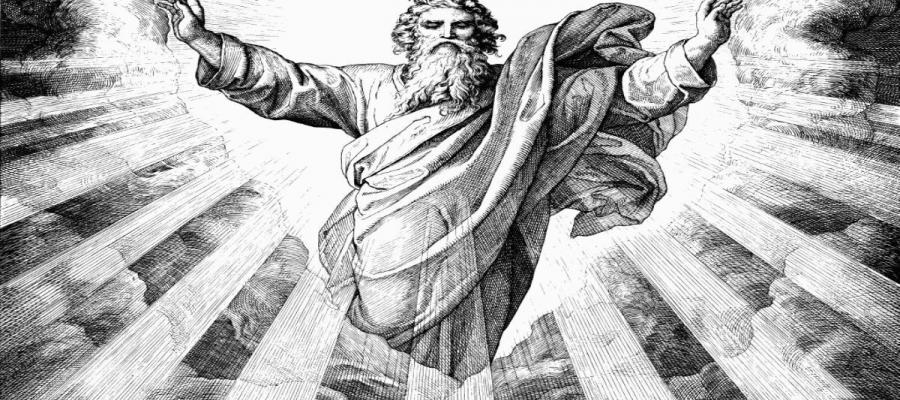
The question is: if God knows all, is all-powerful, and is benevolent, why did He create a world with suffering, evil and injustice in it? That’s what philosophers call “The Problem of Evil”. It is a problem for religions, like orthodox Christianity, that posit a perfect God. Such a God should be all-powerful or “omnipotent,” and all-knowing or “omniscient”. And he should be benevolent, since being mean and uncaring is an imperfection. But as the quote from Epicurus shows, the problem predates Christian philosophy and theology.
This Sunday we’re asking about Good, Evil, and the Divine Plan.
The question is: if God knows all, is all-powerful, and is benevolent, why did He create a world with suffering, evil and injustice in it? That’s what philosophers call “The Problem of Evil”.
The first and best statement I know of is from Epicurus, around 300 B.C.,
Is [God] is both able and willing [to prevent evil],
Then whence cometh evil?
Is he neither able nor willing?
Then why call him God?
It is a problem for religions, like orthodox Christianity, that posit a perfect God. Such a God should be all-powerful or “omnipotent,” and all-knowing or “omniscient”. And he should be benevolent, since being mean and uncaring is an imperfection. But as the quote from Epicurus shows, the problem predates Christian philosophy and theology.
One more bit of termionology. A “theodicy” is a defense against the problem of Evil, an explanation of how there can be evil in world created by a perfect God.
I think Saint Augustine’s theodicy, which has been the pattern for most subsequent defenses of God on this issue, successfully solved one important aspect of the problem of evil, the logical problem of evil. This is the claim that it is just plain logically impossible for a world created by a perfect being to have any evil and injustice in it.
The logical problem of evil isn’t the whole problem of evil. Even Augustine or some other philosopher manage to show us that it is a logical possibility that a perfect God created some world with evil and injustice in it, that would be a far cry from showing that an all perfect God was anything like a remotely plausible explanation for this world, with its particular evils and injustices. That’s the empirical problem. Showing that something is logically possible, isn’t the same as showing that it is empirically plausible. But it’s an important first step.
Augustine presents two connected ideas, which I’ll call the Big Picture Defense and the Free-Will Defense. The Big Picture Defense starts with the idea that something that in and of itself seems quite ugly, and would, by itself, constitute a perfectly ugly picture, might be an essential part of a larger picture of which it is a part. A little bit of ugliness might make the Big Picture better, more aesthetically powerful.
By analogy, maybe a little suffering makes an essential contribution to an overall result that is better than we could have had without the suffering. To take a trivial example, I suffer a little when I jog. The jogging makes me healthier physically, and the suffering makes me stronger mentally. My life, with a little suffering, is better than it would be with no suffering.
If we had the big picture, an understanding of God’s whole creation, which as human of course we don’t have, we’d see that what we take to be injustice and suffering is compensated for; the whole turns out better for these ugly parts. They are necessary parts of the best of all possible worlds, as Leibniz liked to put it.
Then the Free-Will Defense adds a crucial and powerful point. A world with freedom in it, where God lets humans and angels make decisions, is better than one without, even if those decisions sometimes lead to pain and suffering. So freedom is an important part of the Big Picture, even when it brings suffering and injustice with it.
Do you think the logical problem is solved? Even if it is, there is a lot left to discuss. For one thing, a lot of suffering and evil, like the pain a fawn feels when it is eaten by a coyote, doesn’t seem to be related to human free will.
Or coyote free will, for that matter, since I don’t think most coyotes have the capacity to kill fawns painlessly. But who knows.